
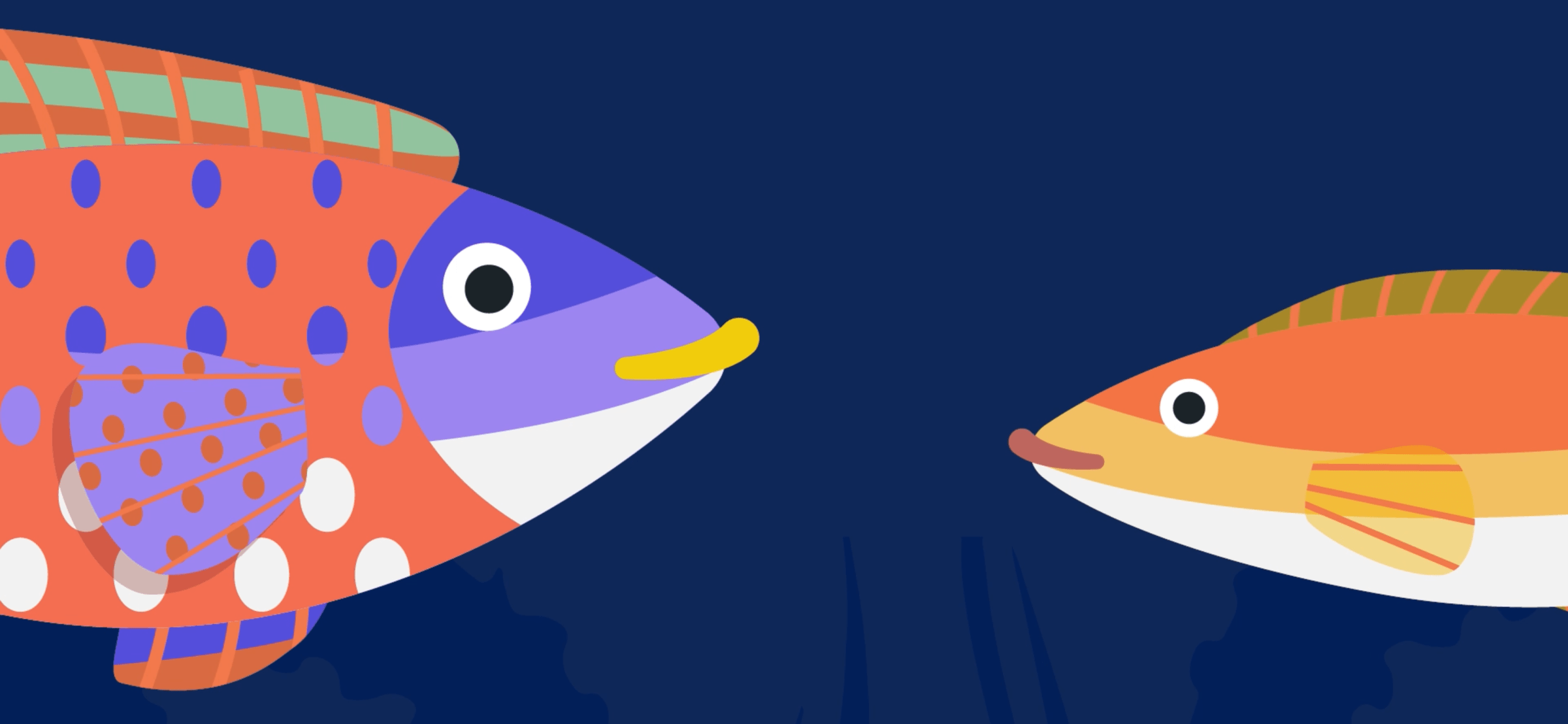
Today, I’m telling a kid’s story about summer solstice below the waves to make a bigger point about how the ocean ecosystem and seasons interact.
Sparkle and Shimmer
Sparkle and Shimmer are herrings, small fish that live in a silvery shoal with hundreds of friends and family. It’s the summer solstice, the longest day of the year and sunlight is pouring down through the blue water in golden ribbons.
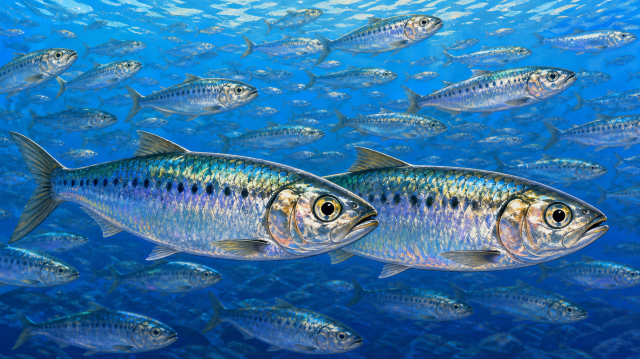
Shimmer tells Sparkle “I’m so excited about today because I know what the solstice means for us: the long hours of sunshine help to grow more and more and more of the tiny floating algae near the surface. And that green soup is gobbled up by tiny floating animals and then they can lay lots and lots and lots of eggs that grow into the food that feeds our our food: yummy slightly larger animals, like our favourite snacks, the copepods and small krill!”
“Hmmmmm!” says Sparkle, “I can’t wait to fill my tummy with so little effort, just swim around, open my mouth and let it all float in!”
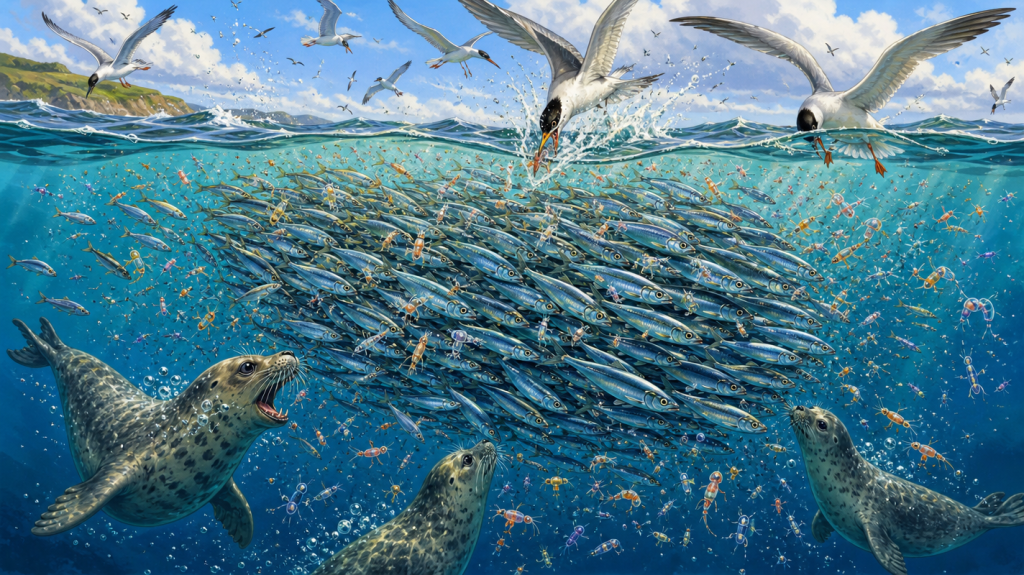
“But we must be careful“, warns Shimmer, slightly worried, “we have to stay alert, because the bigger fish, seabirds, seals and even whales all look out for us for a herring supper. Let’s stay together with our friends because there is safety in numbers, mesmerising hunters as we all swim together.“
“That’s true, but this is also part of our purpose in life: we are an important link in the food web that turns the sun’s energy and tiny algae into food that powers all life in the whole ocean!” Trust Sparkle to see the bigger picture!
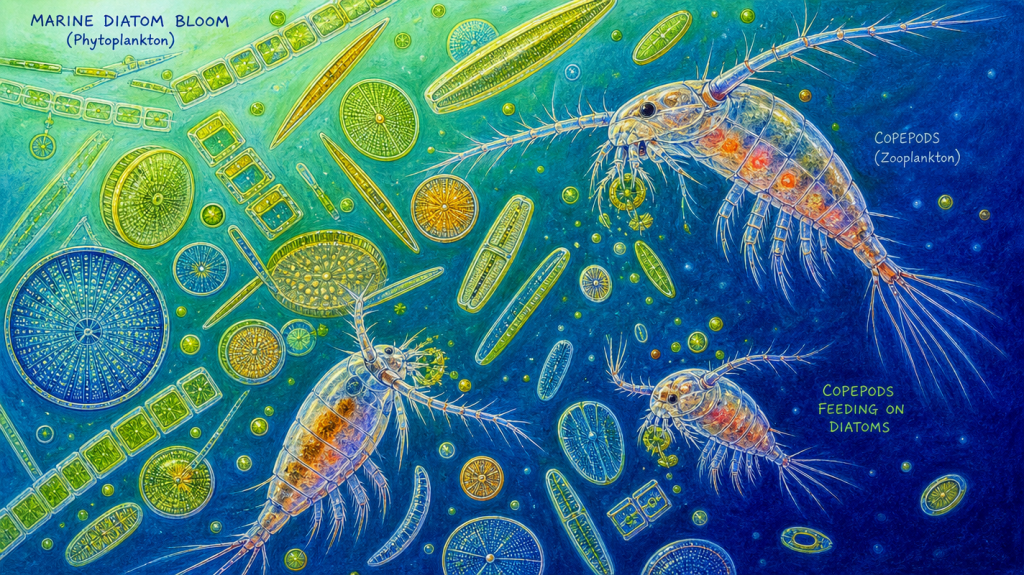
Many different forms of tiny floating algae (diatoms) and tiny floating animals called copepods (a form of zooplankton) feeding on the algae.
Seals and seabirds feeding on herring feeding on copepods feeding on tiny algae – the ocean food web. (both drawn using Power Director 365 as above).
Ocean Solstice
We know the summer solstice marks the longest day and shortest night of the year – but what does it mean for the marine ecosystem? The story of Sparkle and Shimmer only tells part of the story.
The seasonal peak in daylight, solar energy and surface warming around the summer solstice contributes to the timing of high productivity, feeding and breeding behaviour in marine ecosystems, from microscopic algae (phytoplankton) and animals (zooplankton) to fish of all sizes, seabirds and marine mammals [1].
Phytoplankton at the base of the marine food web depend on the availability of sunlight, carbon dioxide and nutrients to grow. In spring, as days lengthen and the upper ocean becomes brighter, phytoplankton can multiply rapidly if enough nutrients are present. By the time of the solstice, many temperate and high-latitude waters have already experienced a major spring bloom. This bloom feeds zooplankton, which are then eaten by small fish, shellfish larvae and other animals. In this way, the extra daylight around the solstice helps fuel a chain of productivity that supports much larger species [2].
However, more sunlight does not always mean more growth. As the sun warms the sea surface, the upper layer of water becomes lighter and more stable, creating stratification. Stratification can be beneficial because it keeps phytoplankton near the well-lit surface, but it can also reduce the mixing that brings nutrients up from deeper water. Phytoplankton growth begins to slow after the spring bloom when nitrate, phosphate and silicate have been used up. In that case, ecosystems shift from intense bloom conditions to a more nutrient-limited summer state around and after the summer solstice [1].
Longer days and warmer surface waters affect breeding, feeding and migration patterns of many marine animals. For example, fish time their spawning so that their larvae hatch when plankton prey are abundant. Seabirds raise chicks during this period of high productivity, feeding on large zooplankton and fish. Marine mammals follow seasonal movements of fish and gather in feeding grounds where summer productivity is high. One dramatic example of the latter is the migration of the great whales to polar seas to feed on krill and herring in near-continuous daylight to build reserves that must sustain the animals through much of the year [3].
Such seasonal behaviour makes ecosystems vulnerable to the effect of human activities: in particular, climate change is altering some of the natural patterns associated with the solstice. Warmer seas can strengthen stratification, shift the timing of algal blooms and change which species thrive in a given location. If plankton blooms occur earlier than the hatching of fish larvae or the breeding of seabirds, food webs become mismatched. Marine heatwaves before the height of summer may also stress kelp forests, corals and cold-adapted species, which are important breeding grounds for many marine species. The location and type of food sources may shift, with potentially dire consequences for predators and their fecundity [4].
So, the summer solstice is not just a marker of the longest day, it is part of a wider seasonal rhythm that governs light, temperature, nutrients and life cycles across marine ecosystems. Its influence is powerful when the natural balance between sunlight, ocean mixing and temperature is in tact. The ability of marine species to keep pace with a changing climate is becoming a key factor shaping the future of the ocean ecosystem [5, 6].
References
[1] NASA. no date. Plankton Blooms – the good, the bad and the shiny. Nasa Earthdata CZCS Classic Scenes. [online] https://www.earthdata.nasa.gov/data/instruments/czcs/classic-scenes/plankton-blooms-good-bad-shiny
[2] NOAA. 2026. Aquatic food webs. National Oceanic and Atmospheric Administration. [online] https://www.noaa.gov/education/resource-collections/marine-life/aquatic-food-webs
[3] Hodgson BR. 2005. Global importance of supporting the krill to whale component of the pelagic food web associated with migrations following deep sea seamounts. International Marine Science Journal, 1(3), 17-33.[online] https://openaccesspub.org/article/2201/imsj-25-5590.pdf
[4] MB&S. no date. Marine heatwaves are pushing ocean life to the breaking point. Marine Biodiversity & Sustainability Learning Center. [online] https://www.marinebiodiversity.ca/marine-heatwaves-are-pushing-ocean-life-to-the-breaking-point/#google_vignette
[5] NOAA Fisheries. no date. Oceans and climate change: Tracking and predicting the impacts. National Oceanic and Atmospheric Administration. [online] https://www.fisheries.noaa.gov/topic/climate-change/understanding-the-impacts
[6] Cheng L et al. 2025. Ocean stratification in a warming climate. Nature Review – Earth and Environment 6, 637-655. [online] https://www.nature.com/articles/s43017-025-00715-5
 Challenging Habitat