
To me, life is about curiosity and learning and growing. I love talking and working with people who have different backgrounds and expertises, because there is always the potential for a surprise, a fact, a story, a new understanding …
Izzy, marine biologist and seasoned Pelican of London sailor and scientist, joined me once more for the Plymouth Ocean Science Voyage1 this September. We had 27 teenagers from Devon and Cornwall on board and I didn’t make it ashore at Lulworth Cove, where we had anchored for carrying out research projects. I was advising groups working on board and off the RIB.
I first learned about limpet gardens when trainees got back on board and worked up their data into talks to be given the following day. Inspired by Izzy’s knowledge about rocky shore ecology, Florence, Lydia, Hannah and Rhyley researched how limpets are adapted to life on the rocks and measured the size of rock pools and limpet gardens.

Limpet gardens!?!?!?
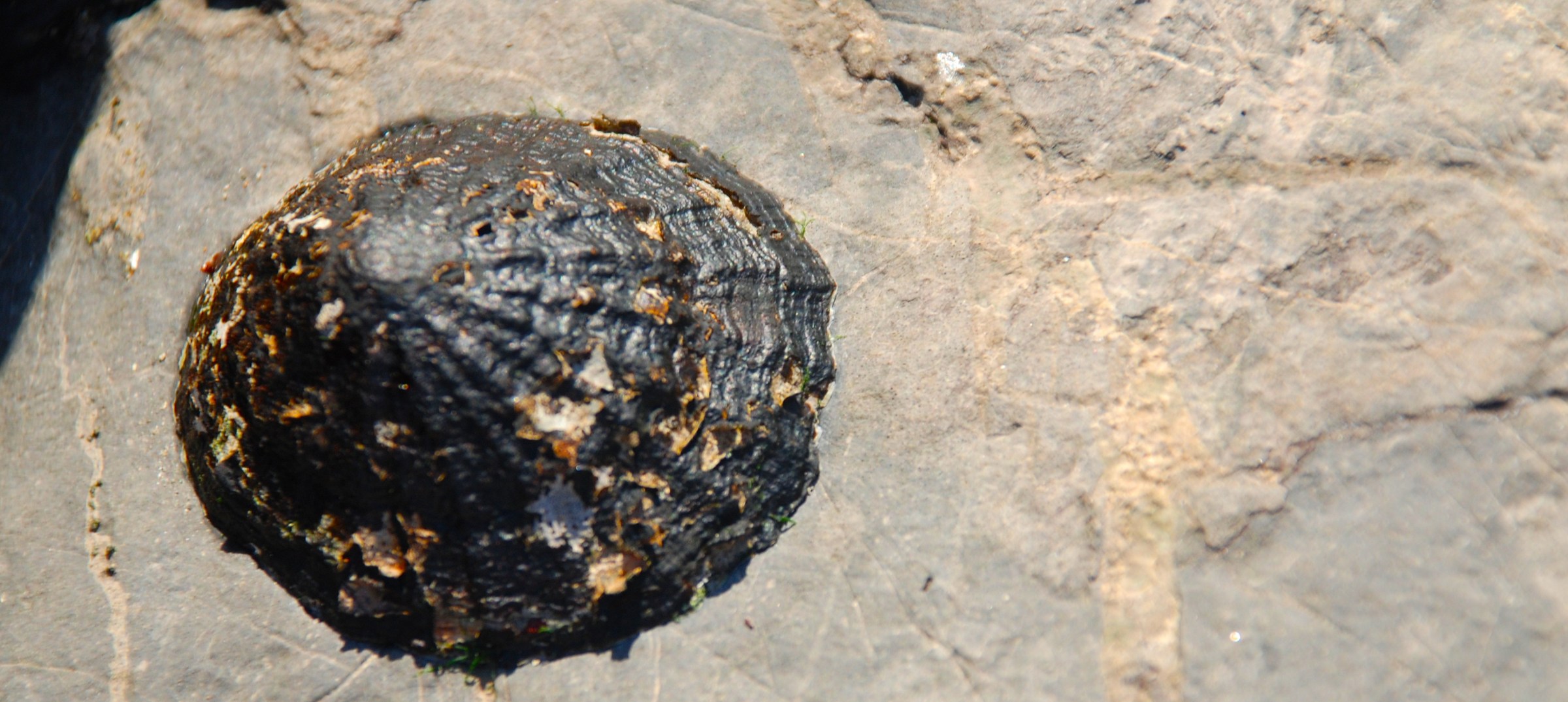
There it was: a concept I had heard nothing about before! Limpets are territorial and always return to the same spot (their ‘home scar’) on the rocks when the tide goes out, where they settle until the water comes back and they continue their grazing. So far, I knew, and it is a common story about our common limpet Patella vulgata, for example on the website of The Wildlife Trusts.
But what about the gardens? I learned that limpets look after a patch of rock in several ways:
- they clear their ‘garden’ by scraping off other organisms, detritus and algae
- they excrete nitrogen-rich ‘fertiliser’ to promote algal growth
- they graze their garden in a patchwork fashion, depending on localised algal density and algal type
- they defend their garden from other limpets.
Limpet gardens are not only important food sources for limpets, but serve as ecosystem regulators: by managing their gardens, limpets prevent the development of monocultures and promote biodiversity for the whole rocky shore ecosystem community and enhance its resilience against climate change.
For this to work, limpets have a couple of superpowers: the teath on their ‘tongue’ are made from the strongest biological substance on Earth (a composite of the iron mineral goethite and protein) and superior navigation skills [The Power of Limpets].
It’s good to learn new things and think differently (out of the box?) sometime, so I finish this blog post with a quote by Frankie Gerraty from The Urban Field Naturalist Porject:
Perhaps Owl Limpets and their symbiotic algae can offer us lessons of care and interdependence, which we might carry into our relationships with the other-than-human companions that we share our living spaces with.
- The Plymouth Ocean Science Voyage is an annual event since 2022, where students from Lipson Co-Operative Academy and, since 2024, students from Callington Community College, receive sponsorship to come on board the sail training tall ship Pelican of London for a 10 day voyage of discovery. In 2022, the voyage sailed from Dublin to Barrow, in 2023, from Plymouth to Dartmouth and Falmouth, In 2024, from Plymouth to the Channel Islands and in 2025 from Plymouth to Lulworth Cove. ↩︎
 Challenging Habitat