

Two years ago, I read an article in Nature News called “Catastrophic change looms as Earth nears climate ‘tipping points’‘ [1], referring to the Global Tipping Points Report 2023, the article warned about Arctic and Antarctic ice, coral reefs and other Earth system poised to cross thresholds in their decline that are irreversible and that threaten the stability of the Earth system as we know it.
Now ‘Team Earth’ have crossed the first of around 20 climate change tipping points [2]: the international group of scientists working on the Global Tipping Points Report 2025 [3] suggest that this year’s extent of coral bleaching and death mark Earth’s first climate tipping point being reached.
The foreword to the report by André Aranha Correa do Lago, President Designate of COP30, talks of urgency and possibility [3].
So, what’s next?
First, let’s define tipping point:
Merriam-Webster: “the critical point in a situation, process, or system beyond which a significant and often unstoppable effect or change takes place“.
Met Office: “a critical threshold in the earth’s system or related processes which, if passed, can cause sudden, dramatic or even irreversible changes to some of the easrth’s largest systems, such as the Antarctic ice sheet or the Amazon rainforest.”

Graphic from What is a tippint point by Global Tipping Points 2023.
Evidence for the urgency of climate action:
Even before reaching tipping points, human-induced climate change causes widespread impacts and altered terrestrial, freshwater and ocean ecosystems worldwide. The graphic below shows the observed (1900-2020) and projected (2021-2100) changes in global surface temperature (relative to 1850-1900), which are linked to changes in climate conditions and their impacts [4]. It starkly illustrates the change in climate throughout the life span of three representative generations, born in 1950, 1980 and 2020, respectively.
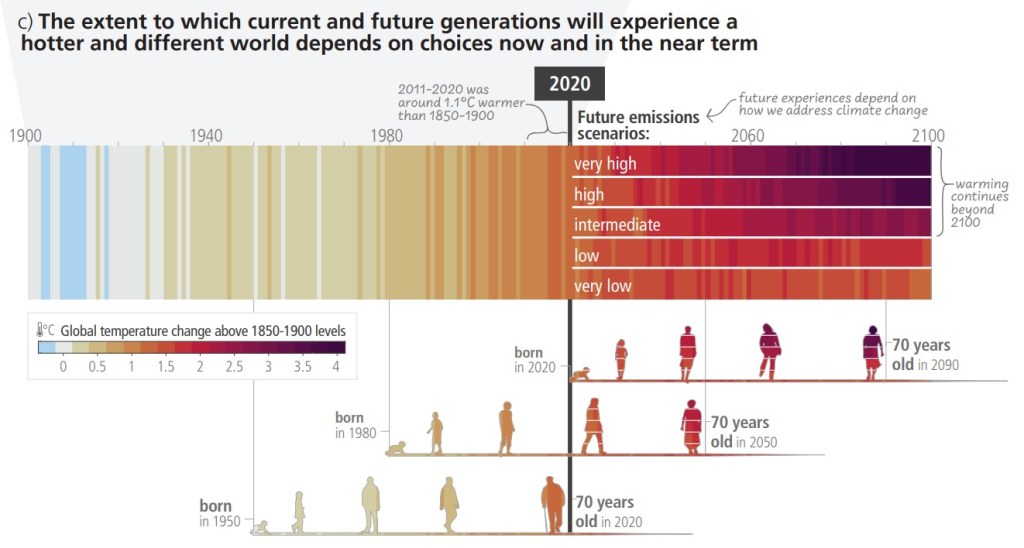
Graph from the Climate Change 2023: Synthesis Report by the IPCC [4].
The infographic below illustrates the average global temperature rise under global policy scenarios and projections that limit greenhouse gas emissions and/or promote carbon sequestration to different degrees. It also shows the temperature ranges for reaching projected tipping points [3]. As of today, we have reached around 1.3oC to 1.4oC average global warming above pre-industral levels [5].
According to the Global Tipping Points Report 2025, coral reef die-off has reached its tipping point [3] in a succession of years that saw the term marine heatwave appear in the national news and social media alike, typically associated with their devastating consequences for coral reefs, fisheries, coastal communities and charismatic wildlife [6]. The die-back of warm-water coral threatens the livelyhood of coastal commumities that depend on their value as nursery for marine life, protective shield from storm surges and amenity.
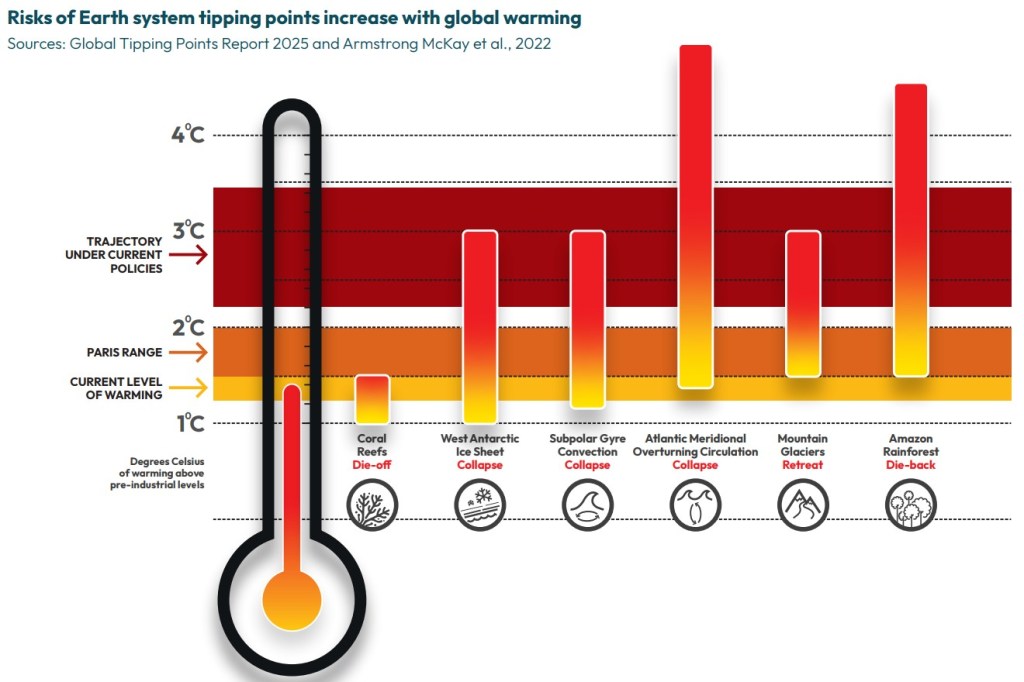
Graph from the Global Tipping Points Report 2025 [3].
Other tipping points appear far off in the graphic, although we only know of the likelyhood of these thresholds being reached because scientists have spotted signs of decline already:
- The West Antarctic Ice Sheet has been monitored by scientists since the 1990s. They observed ‘an abrupt acceleration in ice melting, retreat and speed‘ of two unstable glaciers (Pine Island and Thwaites) in the region, as well as variations in decline that offer hope for avoiding the tipping point, should appropriate climate change action be taken rapidly [7]. Several meters of sea level rise are the projected consequence of the Ice Sheet’s collapse.
- The role of the Subpolar Gyre, a large ocean current in the North Atlantic Ocean, in global climate regulation and ocean fertility has been known for a couple of decades. The research into the potential of the current collapsing as a result of increasin stratification of the water column caused by ocean warming is relatively recent, and its effects on the ocean ecosystem and NW European climate remain largely unknown [8].
- The Atlantic Meridional Overturning Circulation (AMOC), which includes the surface current known as the Gulf Stream, is a large-scale ocean circulation system that connects polar and tropical regions of the North and South Atlantic. It transports energy (heat), salt, carbon and nutrients in surface and deep water and contributes to climate regulation and ecosystem functioning [9]. Research suggests that AMOC has been weakening for decades (read previous blog posts here and here). In the graph above, the predicted temperature of AMOC collapse is the highest, perhaps because its projection is controversial and uncertainty remains large.
- The retreat of mountain glaciers has been observed for over 100 years on all continents, from the Himalayas and New Zealand’s Southern Alps to the Rocky Mountains and Andes in the Americas and Alps in Europe. Some have disappeared entirely, others are greatly reduced and some shrink faster than others [10]. After the end of the little ice age (1550 – 1850), glaciers retreated as a result of natural warming, but since the 1980s, human-induced climate change accelerated the process. Changes in the Earth’s reflectivity (albeido) and water supply and sea level rise are impacts that affect ecosystems and human systems alike.
- As the world’s largest tropical forest and most diverse ecosystem, the Amazon rainforest plays a key role in global climate regulation, the Earth’s hydrological and carbon cycles. Already much diminished and fragmented by deforestation that causes reduced rainfall at a regional scale, research suggests that increasing global temperatures will push the system beyond the tipping point [11]. The associated loss of the rainforest’s ecosystem services (carbon uptake, climate regulation, biodiversity) can only be prevented by protecting the existing forest from deforestation and taking rapid action to limit global warming.
All of this makes for tough reading and thinking: planet Earth has entered a new reality of irreversible impacts of human-induced climate change that fundamentally undermine the life-sustaining ecosystem services upon which humanity depends [2].
Planet Earth’s sytems are interconnected, which means that tipping one systems makes tipping another more likely [3], with consequences for all lof us. What we do with this information, by how much and how fast we curb green house gas emissions and how rapidly we push sustainable carbon removal from the atmosphere – in other words, with how much urgency we act – will determine and the extent and duration of human-induced global warming and how habitable an environment our children and grandchildren inherit.
That brings us to possibilities:
The Global Tipping Point Report 2025 [3], as other reports in the past [4], calls for urgent action. It also introduces the concepts of positive tipping points: when what we do or promote to trigger self-propelling change towards a more sustainable state.
For example deliberate actions can enable positive tipping by making a desired change the most affordable, accessible and/or attractive option for people, organisations or businesses to choose. For example, at a global level, the adoption of solar PV and wind power has already passed tipping points. Hereby, the interaction of different systems creates opportunities, such as improved battery technology can increase the likelihood of tipping another sector (e.g. electric vehicles, renewable energy) [3].
The idea of positive tipping points is relatively new and there is a need for better understanding of their mechanisms and dynamic, and the required policy design, governance, financing, commuinication and coordination of efforts. Check out ‘Positive Tipping Points in Action‘ for more information on possibilities already underway [3]:
- Heat Pumps https://youtu.be/or1iqpPsZuo
- Electric Vehicles https://youtu.be/MNj-X0273w4
- Green Hydrogen https://youtu.be/5IypGvHuoLU
- Solar and Storage https://youtu.be/_-R7kGwXkNU
- Alternative Proteins https://youtu.be/ytyeKrgZAjU
At a global level, it is going to be interesting to watch the COP30 negotiations in November 2025, given that some nations’ pledges to cut CO2 emissions by 10% by 2035 fall far short of the required cuts (57%) needed to limit global warming to 1.5°C [12]. Meanwhile, hurricane Melissa inches towards Jamaica and provides a case study of the increase in and severity of extreme weather events we are already experiencing.
Ultimately, all of humanity needs to work together at whatever level of organisation we can. While most of us have limited influence on a lot of global factors that affect tipping points (positive and negative), as individuals we can start with more sustainable travel (e.g. walking, cycling, trains), nutrition (e.g. think of protein sources, food miles, seasonal plants, packaging, processing, waste), clothing (e.g. natural fibres, quality, second hand), stuff (think of necessity, longevity, repairability, recyclability) and energy (e.g. solar PV and thermal panels, heat pumps, renewable electricity suppliers) and check out more ways to live more sustainably (e.g. FoE, BBC, GreenMatch, BedZED, and many, many more) .
References
[1] Tollefson J. 2023. catastrophic change looms as Earth nears climate ‘tipping points’, report says. Nature News 06/12/2023. online: https://www.nature.com/articles/d41586-023-03849-y
[2] Tollefson J. 2025. Coral die-off marks Earth’s first climate ‘tipping point’, scientists say. Nature News 12/10/2025. online: https://www.nature.com/articles/d41586-025-03316-w?utm_source=Live+Audience&utm_campaign=8d17a3f2e2-nature-briefing-daily-20251013&utm_medium=email&utm_term=0_-33f35e09ea-50551124
[3] Lenton TM, Milkoreit M, Willcock S et al. (eds). 2025. The Global Tipping Points Report 2025. University of Exeter, Exeter, UK. online https://global-tipping-points.org/.
[4] IPCC. 2023 Climate Change 2023: Synthesis Report. Contribution of Working Groups I, II and III to the Sixth
Assessment Report of the Intergovernmental Panel on Climate Change [Core Writing Team, H. Lee and J. Romero (eds.)]. IPCC,
Geneva, Switzerland. online https://www.ipcc.ch/report/ar6/syr/
[5] United Nations. 28 May 2025. Climate change: World likely to breach 1.5oC limit in next five years. UN News Global perspective Human stories. online https://news.un.org/en/story/2025/05/1163751
[6] Smith KE, Gupta AS, Burrows MT et al. 2025. Ocean extremes as a stress test for marine ecosystems and society. Nature Climate Change 15, 231-235. https://doi.org/10.1038/s41558-025-02269-2
[7] Collins S. 2023. New research finds that ice-sheet-wide collapse in West Antarctica isn’t inevitable: the pace of ice loss varies according to regional differences in atmosphere and ocean circulation. University of Cambridge. online https://www.cam.ac.uk/stories/west-antarctica-ice-retreat
[8] Kelly S, Popova E, Yool A et al. 2025. Abrupt changes in the timing and magnitude of the north atlantic bloom over the 21st Century. JGR Oceans, 19/03/2025. https://doi.org/10.1029/2024JC022284
[9] NOAA. 2025. New insights into deep ocean cooling in the Atlantic. National Oceanic and Atmospheric Administration, Atlantic Oceanography & Meteorological Laboratory. online: https://www.aoml.noaa.gov/new-insights-into-deep-ocean-cooling-in-the-atlantic/
[10] WGMS. 2023. Zemp M, Gärtner-Roer I, Nussbaumer SU et al. (eds.), ISC(WDS)/IUGG(IACS)/UNEP/UNESCO/WMO, World Glacier Monitoring Service, Zurich, Switzerland, 134 pp., publication based on database version: doi:10.5904/wgms-fog-2023-09.
[11] Franco MA, Rizzo LV, Teixeira MJ et al. How climate change and deforestation interact in the transformation of the Amazon rainforest. Nature Communications 16, 7944 (2025). https://doi.org/10.1038/s41467-025-63156-0
[12] UNEP press release 24/10/2024. Nations must close huge emissions gap in new climate pledges and deliver immediate action, or 1.5°C lost. United Nations Environment Programme. Online https://www.unep.org/news-and-stories/press-release/nations-must-close-huge-emissions-gap-new-climate-pledges-and
 Challenging Habitat
Pingback: Embracing the Challenge | Challenging Habitat