
I am a fan of crowd-sourcing scientific data. I know it has its challenges, not least relating to quality control and assurance, but in my view that is balanced by the added value of engaging the public in the scientific process.
As a scientist without a laboratory, I participate in citizen science on a weekly basis, using smartphone apps. I log the clouds in the sky for NASA while taking my dog out in the morning. When I spot seals, dolphins or whales on coastal walks or from my boat, I record them on Sea Watcher and occasionally, I use BirdTrack to report the birds I see while paddling along on the Tamar Estuary.

Citizen science has become an important part of sourcing data for research in fields that range from conservation to the effects of climate change, habitat fragmentation and pollution. It is also a great way of learning something new about nature, our interaction with it and how scientific investigations are undertaken. Many organisations share insights gained from crowd-sourced data and show how it is used.
For all of these reasons, the Seas Your Future summer voyages are now packed with citizen science activities, as our STEM Leads, Scientists in Residence and Professional Crew introduce trainees to the concept of crowd-sourcing data and involve them in marine mammal and bird surveys, recorded beach litter picks, invasive species hunts, meteorological observations and the like. If you have not seen our reports, check out the Ocean Science page on the SYF website.
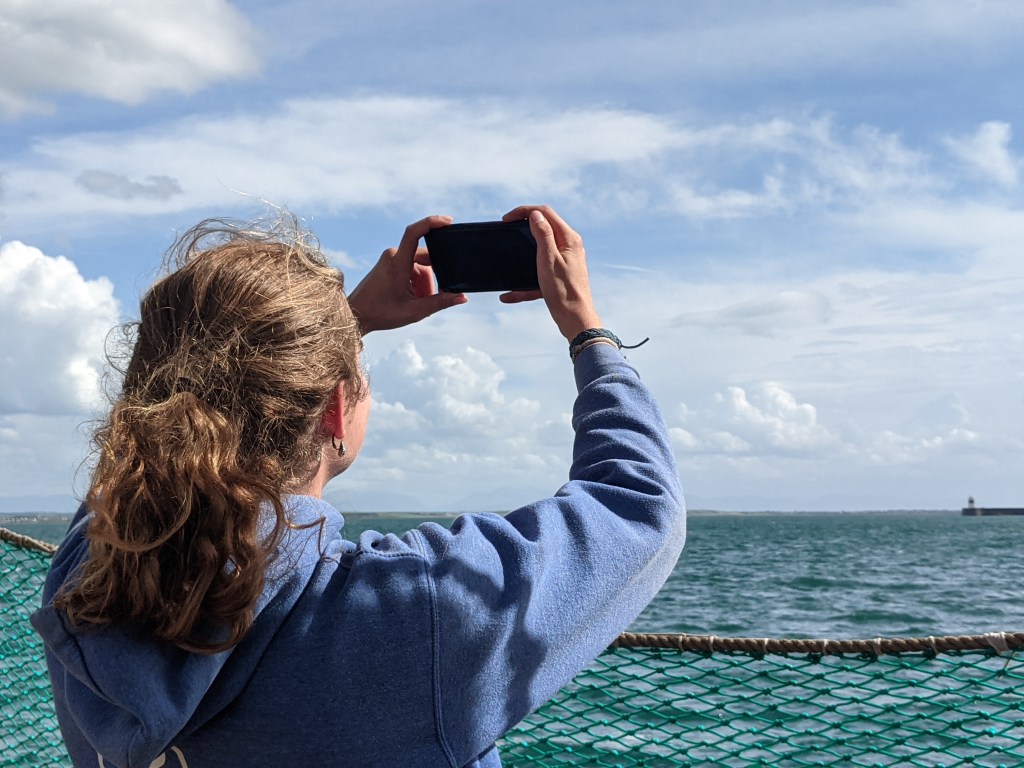
NASA Globe Observer Cloud observation from the deck of Pelican of London, Welsh coast. (c) C Braungardt 2022
I stumbled over an article in The Marine Biologist* by Bob Brewin, who highlighted the next step in marine citizen science: fitting low-cost, high-tech equipment to frequently used leisure equipment with the aim to monitor how the marine environment is changing.
In terms of marine environmental change, 2023 has already been quite a year:
- The European Space Agency reported that since 1992, seven of the highest ice melting years in Greenland and Antarctica occurred in the last decade.
- The terminology marine heatwave has entered public consciousness with widespread reports in the press, fuelled by an unprecedented 44% of the global ocean currently experiencing marine heatwaves, more than records began in 1991.
- Evidence is mounting that the meltwater poring into the North Atlantic weakens the Atlantic Meridional Overturning Circulation (AMOC), part of which is more commonly known as the Gulf Stream, to a point where the circulating current may collapse with major effects on climate in the North America and Europe.
Scientific knowledge is like a complex building with diverse spaces that fulfil many different functions. Like a building, it relies on solid foundations (data) and multi-disciplinary contributions of many individuals. There are limits to this analogy: science has no roof that stops expansion, each building block is an improvement on the previous one and even the ‘dead ends’ provide information on how not to do things next time. We don’t dismiss the contributions made by our predecessors, each one provides a valuable lesson to move on from, a stepping stone that enables us to ask the next question, to develop more sensitive instrumentation and new equipment, to refine a model with more data, more powerful computing capabilities and artificial intelligence applications.
Uncertainty of what our past and future look like has haunted humankind for millennia and driven civilisations around the globe to create stories of creation and destiny. Today’s uncertainties are no more comfortable than those of old and although scientists have found out a lot about our planetary past and generate increasingly sophisticated models of future environmental scenarios, we know from experience that the answers we find today are superseded by the quest to resolve the riddles that arise from them. Just think of the advances in climate science charted by the Intergovernmental Panel on Climate Change (IPCC) in their reports since 1990!
Predicting environmental changes is a data-hungry business and although remote satellite sensing and autonomous monitoring equipment on buoys or drifters provide an incredible array of global data, there is still a need for individual data collection. One example that Bob Brewin mentions in his article* are nearshore regions that feature highly variable, very high levels of marine productivity and diversity. Nearshore environments are also frequently used by people and this provides opportunities to use marine recreation as a platform for crowd-sourcing data.

Five years ago, scientists have developed Smartfin, a miniature sensing package that can be integrated into the fins of surfboards, paddle boards and kayaks and measures water temperature, motion and position, and transmits the data to a data centre. In addition to providing open access data to the scientific community, the project provided education and student research experiences, STEM education and outreach and community-building events around the globe. Several thousand hours of monitoring (so far) is used to provide satellite validation and education. An article in Continental Shelf Research from 2022 provides you with the full details of the project so far and is well worth a read.
Needless to say, I’ve contacted Smartfin to discuss the potential for this technology to be used on Pelican of London (watch this space!).
*Reference: Bob Brewin. 2023. Aboard the Marine Monitoring Revolution. The Marine Biologist 25, 25-26.
 Challenging Habitat