
Humans have long been fascinated by whale communications and wondered about their meaning. In a new study of sperm whale clicks, scientists have discovered a surprising likeness to human language.
Whales and the mystery of their communication across thousands of miles of ocean fascinate, a fascination that intensifies once we have encountered whales in the wild.
Recording of whale vocalisations began as a side-effect of studying sonar and underwater explosions in the first half of the 20th century. Just lately, the oldest known recording of a humpback whale, captured in March 1949 near Bermuda, was rediscovered at Woods Hole Oceanographic Institution. With advances in underwater microphone (hydrophone) technology for scientific purposes, the haunting song of whales also inspired our imagination. I link to the video of humpack whale song created by Indoona for its beautiful combination of image and sound.
Sperm whales have for long attracted human attention for the wrong reasons: they were nearly hunted to extinction for their spermaceti oil between the 1800 and 1987. Although the moratorium on commercial whaling by the International Whaling Commission was placed in 1986, sperm whale populations are still recovering, but now facing new dangers, such as entanglements, pollution, collisions with ships and ocean noise.
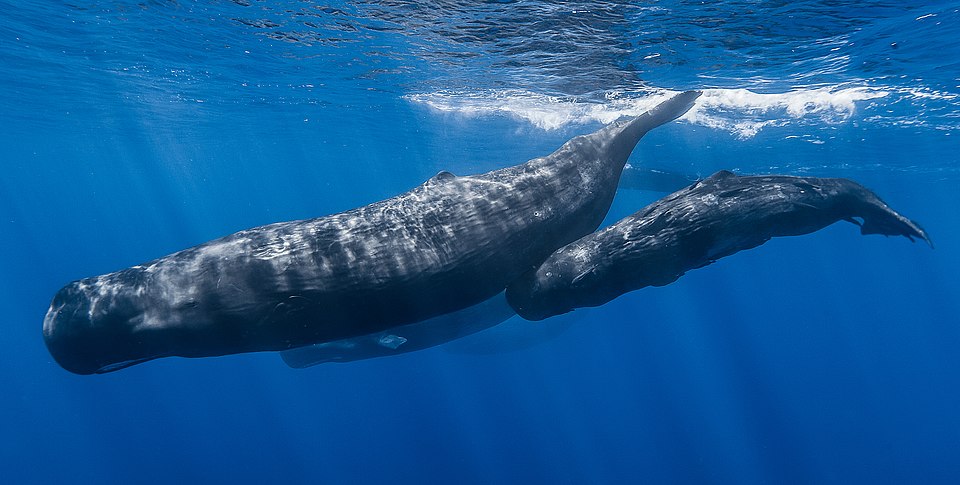
Sperm whales are like no other creature on Earth: they are the largest of the toothed whales, sleep upright, hunt in the deep ocean, where they can remain for 2 hours and are the only living cetacean that has a single blowhole on the left side of their head. The right blowhole evolved to play a role in sound production and echolocation, in a similar way to that in dolphins, who also only have one (albeit centrally located) blowhole. The groups of clicks they produce are called ‘coda’ and are distinctive to individuals.
Recently, cognitive scientists and linguists at the UC Berkeley have analysed sperm whale coda and discovered surprising similarities with human vowels and diphthong spectral patterns that enable complex communication akin to dialogue. Their scientific paper in Open Mind – Discoveries in Cognitive Science provides all detail with very accessible illustrations of human and whale sound generation. Helpfully the lead researcher of the Project CETI (Cetacean Translation Initiative), Gašper Beguš, also produced a short article and video on the UC Berkeley webpage.
Are scientists on the brink to decyphering what they say to each other? Perhaps not just yet. But intriguing possibilities have been expressed by David Gruber, president of Project CETI in The Guardian this week:
“I think it’s another humbling moment that we’re not the only species with rich, communicative, communal and cultural lives…These whales could be passing information along generation to generation to generation for over 20 million years.“
I am glad that in the 1980s, humankind have (largely) stopped the slaughter of the great whales. Now it emerges that we have more in common with these highly intelligent and social creatures than we imagined, it is upon us to protect them from other, more diffuse and multi-faceted dangers. This means protecting their natural habitat by tackling pollution, noise and high-powered sonar, sustainable fishing, reconsidering deep-sea mining, adopting whale-safe shipping practices and restoring a healthy relationship of society with the ocean. In short, fulfilling the vision of the UN Ocean Decade.
Featured Image: Sperm whale pod. “Sperm whale pod” by Gabriel Barathieu is licensed under CC BY-SA 2.0.

