

Growing (up) is all about exploring and once more, sail training on board the tall ship Pelican of London proved to be an excellent vehicle for both, exploring self and the world and finding out how we deal with challenges along the way …
It was past midnight and we were on our way from Dun Laoghaire towards Sir John Rogerson’s Quay in the Liffey, where teenagers from Sail Training Ireland were to embark in the morning. Alas, Tom Clarke Bridge could not be opened for us as planned and we moored up in Dublin Port for the night, resulting in traffic chaos for parents and guardians dropping off trainees.
The next day, seamanship and sail training, making beds, an introduction to ocean science and safety rounds exhausted our trainees, but did not stop their competitive spirit in a wind turbine design game after dinner. For me, it was also heartening to see the youngster’s passion for playing chess and card games.
Shortly after departing Dublin port area, excitement was delivered by the Irish Coastguard who used Pelican for an international training exercise for the highline transfer of a German air crewman onto the poop deck. From our perspective on the well deck, it looked as if the helicopter came very close to the masts and each time the ship rolled in the swell. What a stunning introduction to life at sea for our trainees!
We carried on towards the coast of Wales, sailing through what became an uncomfortable night for many: most trainees experienced sea sickness in a moderate but lumpy sea. Unfortunately, the conditions also prevented crew landing trainees ashore and we were reduced to looking at the town of LLandudno and the limestone cliffs of the Great Orme from afar. Not only is the Great Orme interesting geologically, it also features visitor attractions, such as nature trails, Kashmeri Goats and Bronze Age Archaeology (if you can get ashore).

Never mind, we kept the trainees busy in small groups, in turn climbing the rigging and using our microscope to explore plankton, the tiny world of algae and animals at the base of the oceanic food web.


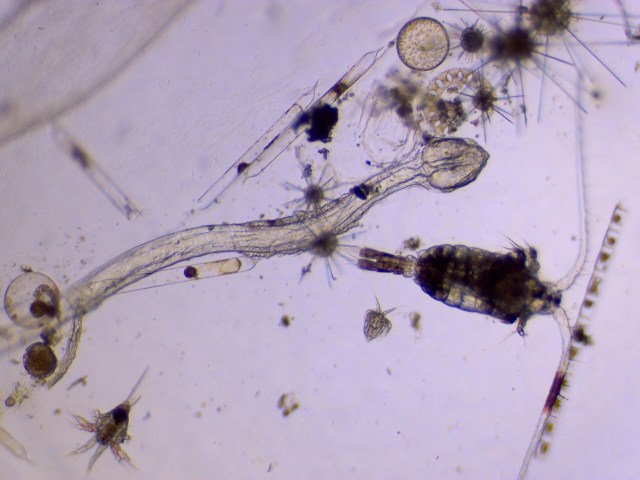
Plankton in a sample from Llandudno Bay under the microscope in September 2025. Clockwise from top left: diverse species of chain diatoms, larva of bryozoan, detail of a jellyfish larva with plastic microfibre (bottom left of the image), diverse species of zooplankton (tadpole-shaped larva of sea squirt, mite-like larvae of barnacles and copepods, and dark body of copepod with long antennae in the centre-right of the image), as well as needle-, chain- and centric diatoms and radiolarians (spiny spheres).
A session on the identification of marine mammals rounded off the science activities of the day, which came in handy on our fabulous sail across to the Isle of Man the next day. We saw quite a lot of common dolphins, a seal and numerous seabirds (gannets, shags, cormorants, gulls, shearwaters, guillemots, fulmars) during a transect survey, the data of which was shared with the Sea Watch Foundation and the British Trust for Ornithology.

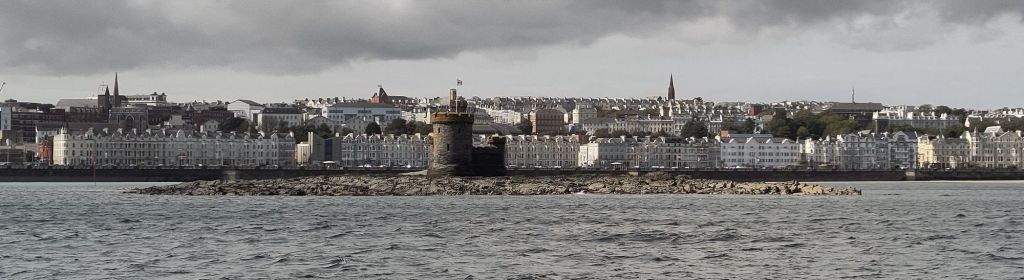
The people of Douglas on the Isle of Man are tidy, the beautiful seafront and sunken gardens spotless, the bonnag sweet, spicy and delicious in equal measures. That’s all very well, but when I went on a mermaid’s purse hunt, the tidiness of this community got in the way: the beaches here are cleaned regularly of seaweed and debris throughout the summer and we didn’t find a single egg case of shark, ray or skate (only a couple of dying lion’s mane jellyfish).
Luckily, I’m keeping some shark and ray egg cases on board, so I was able to underpin my messages about the importance of apex predators in ecosystems and shark conservation with specimen for identification. Some trainees have downloaded the Shark Trust app to learn more about these fascinating creatures, their conservation and contribute data to this charity.


Slack water after dinner allowed an exploration of the seafloor beneath the ship using ‘Shelly‘, a remotely operated vehicle (ROV) that is controlled from the surface and takes video footage in the water. Some of the trainees were on deck to follow the camera’s view live using a tablet and I edited the footage into a ‘highlights’ video, shown below.
As Shelly descended to around 12 m depth, marine snow, the flurry of debris from marine life, indicated a productive and healthy ecosystem in Douglas Bay. The sea floor presented a more troubling picture: Fronds and fragments of different algae lay flat among coarse sediment strewn with small boulders and rocks. While schoals of small fish picked their way among the scarce vegetation and the odd pollock or wrasse come into view, the scene appeared to be one of devastation when compared to a healthy, thriving kelp forest that provides food and shelter for a multitude of species.
What might have happened here? Something flattened the seaweeds, not an anchor or fishing trawler, as it’s too close to the harbour wall, but perhaps the force of the wash from frequent approaches by big ships?
Video of a healthy kelp forest on the south coast of England, in Wembury Bay.
The calm crossing to Bangor provided opportunities for introducing weather forecasting at sea, which involves understanding high and low pressure systems, wind, barometric pressure, dry and wet bulb temperatures and reading the clouds. The latter was playfully developed through playing NUBE, the cloud-focused version of the card game ‘UNO’ that has been recently released by NASA Globe Cloud Observer.

I used the last science session of this voyage to discuss the importance of healthy oceans for all of us: climate regulation, major part of the carbon cycle, heat exchange, nutrient transport and oxygen production are all ecosystem services we depend on.
Meanwhile our trainees stood watch, helmed the ship, set and handed sail, cleaned and helped the cook. They learned new skills and discovered that they can take responsibility even when tired and wet. Sometimes some of the trainees misbehaved a little, as teenagers tend to while spreading their wings, and as long as they learned from the consequences of their actions, even these challenges to the crew and fellow shipmates have a silver lining.
 Challenging Habitat