

It’s a long story that shows the value of perseverance and the benefits of patience mixed with a little fortitude.
My interest in environmental pollution association with metal mining and processing began in the 1990s when I worked as a young engineer for LURGI, a daughter company of the Metallurgische Gesellschaft in Frankfurt.
LURGI was an large engineering consultancy with a very diverse portfolio ranging from metallurgy to scrap recycling, waste incineration to stack emission control, chemical and pharmaceutical processes to waste water treatment…
Working at LURGI gave me my first insights into the environmental consequences of fuelling our consumer society.
Leaving industry behind to study environmental science at the University of Plymouth provided me with the scientific understanding of the natural world that I needed to investigate pathways and impacts of pollutants.
My dissertation investigated the mobility of metal and arsenic pollution in the sediment of Restronguet Creek, a side arm of the Fal Estuary that receives drainage from the heart of Cornwall’s metal mining district, the industrial, cultural and archaeological legacy of which is recognised with the designation as the UNESCO World Heritage Site ‘Cornish Mining’.
My PhD research brought me to the southwestern mining district around Rio Tinto in Andalusia, where the rivers run red with iron and we followed the toxic plume of acid, metals and arsenic all the way from the mountains into the Gulf of Cadiz, through the straits of Gibraltar and into the Gulf of Lions. I say ‘toxic’ because of the impacts on the riverine and estuarine ecosystems.
Further research projects in the UK and France brought a deeper understanding of sources, pathways and receptors of mining pollution, by applying advanced analytical techniques to investigate the biological availability, biological uptake and biogeochemical cycling of potentially toxic elements in water, sediments and soils.
There is something missing in the story so far: as a scientist I can always find another question to investigate, go deeper, find out more…but as an engineer I need that knowledge to lead to action, for solutions to be developed and applied to once more reach good environmental health.
But now, the Environment Agency seek to improve the water quality of rivers of Cornwall and, in collaboration with the Tamara Landscape Partnership, start by focusing on the Luckett Stream in the Tamar Valley to establish a pilot remediation scheme.
Research costs lots of money and remediating legacy mining sites can be even more expensive. Government have to prioritise expenditure and so far, only one full scale mine water remediation project has been financed in the Southwest.
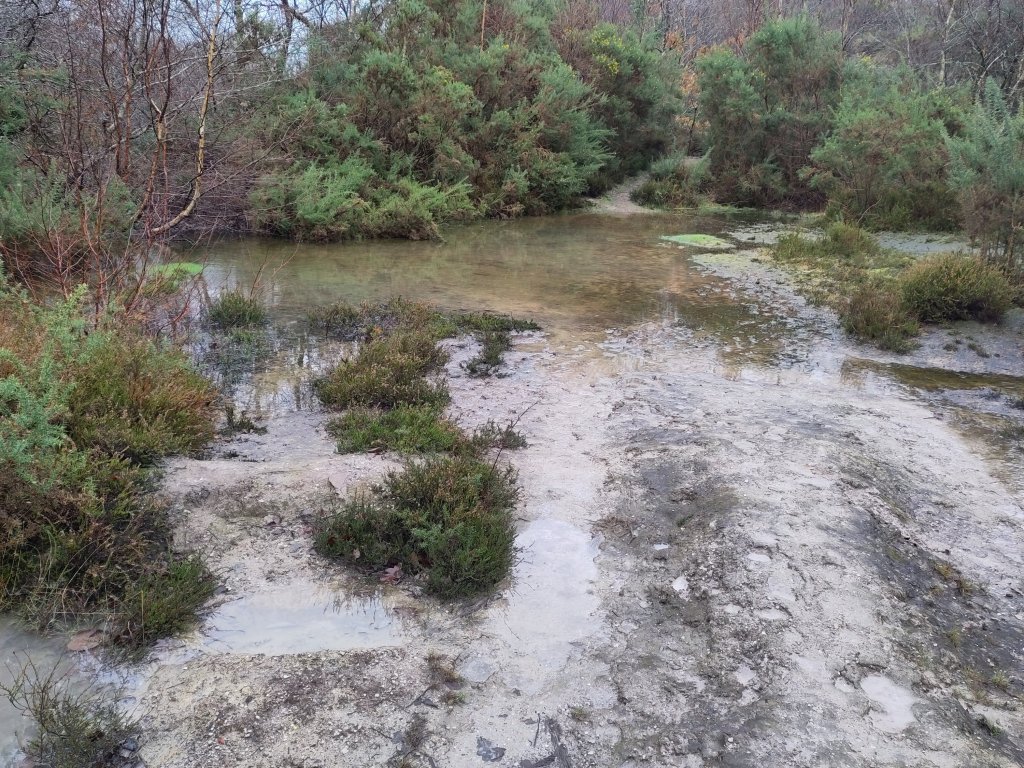
Braungardt 2023
As a freelance consultant, I now have the pleasure to support their work with data and knowledge gained through years of research and with options for sustainable nature-based solutions for the New Great Consols mine site.
Within the next year, remediation works will commence with additional funding from the National Lottery. Long+term monitoring will enable the project team to learn and develop a blue print for other sites.
For me that’s a step in the right direction and gives me a sense of coming full circle.
 Challenging Habitat